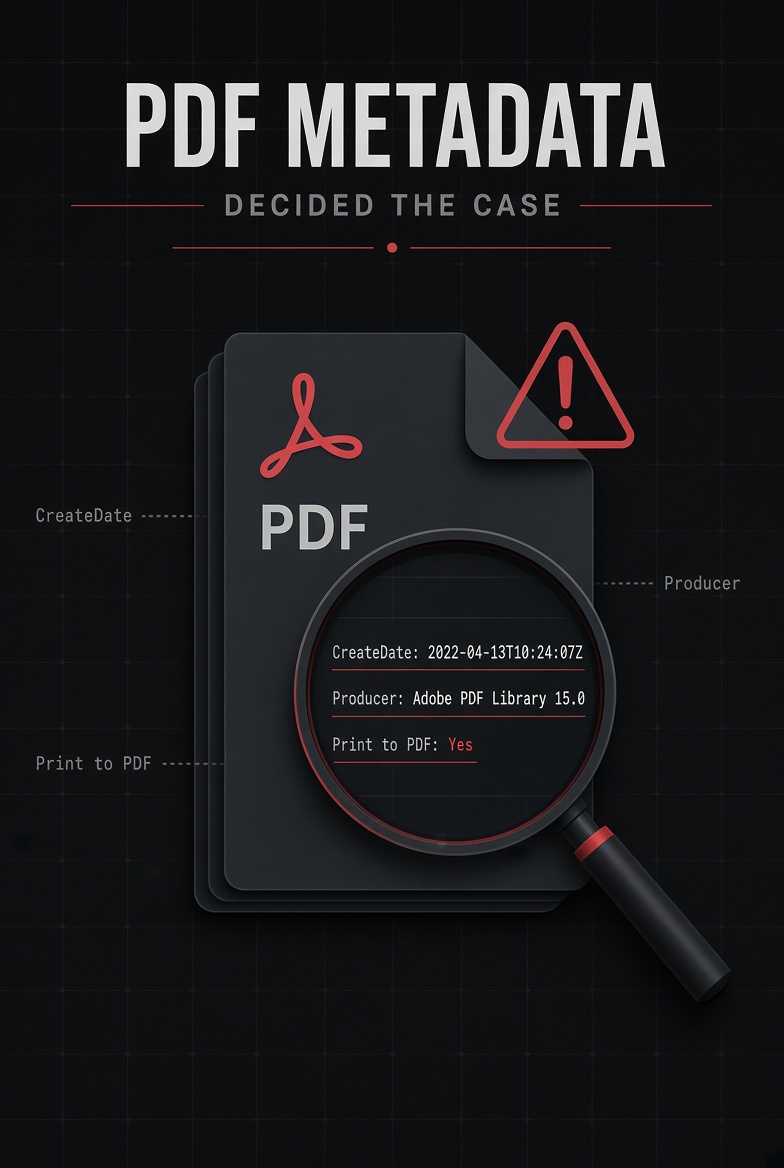

In July 2026, a federal court dismissed an entire $840 million lawsuit against Amazon after forensic examiners proved the plaintiff's key purchase orders had been generated by printing Excel spreadsheets to PDF just two days before they were handed over in discovery, not scanned from paper years earlier as the company had sworn under oath. The case, Gilimex v. Amazon, is the latest in a long line of disputes where a file's metadata, not its visible content, ended up deciding the outcome.
On July 9, 2026, a judge in the Southern District of New York threw out a Vietnamese manufacturer's $840 million lawsuit against Amazon in its entirety. Not just the disputed damages claim. The whole case, including the parts that had nothing to do with the fabrication. The reason came down to a handful of PDF files that were supposed to be scans of purchase orders from 2021 and earlier. They weren't. Buried in their metadata was a creation date of July 31, 2023, two days before the company handed them over in discovery, and a software signature showing they'd been produced by printing an Excel spreadsheet straight to PDF, not scanning a sheet of paper.
That single detail, multiplied across dozens of documents, is what ended an $840 million case. It is also the latest entry in a pattern that goes back more than two decades: metadata keeps deciding cases that look, on the surface, like they should turn on something else entirely: a contract term, a termination letter, a government intelligence assessment. The file's hidden properties end up mattering more than anything a witness says on the stand.
#1. The $840 Million Case That Fell Apart Over a File Extension
Binh Thanh Import Export Production & Trade Joint Stock Co., known as Gilimex, had been one of Amazon's manufacturing partners, producing storage and transport equipment for Amazon's fulfillment network. When Amazon ended the relationship, Gilimex sued, claiming it had been left holding tens of millions of dollars in raw materials it could no longer use, as part of a broader $840 million damages claim against the retail giant.
During discovery, Gilimex produced sixty-six purchase orders and demand letters, together representing roughly $69 million in claimed purchases, and told the court these documents were scans of paper originals from the normal course of business. A digital forensics expert retained in the case found that at least thirty-six of those documents carried file-creation metadata and title fields consistent with having been generated using Excel's print-to-PDF function, all on the same date, two days before production began. The underlying Excel files were never turned over.
When Gilimex was pressed to explain the discrepancy, the company's account kept shifting: first that the documents were photographed, then that the photographs were converted into Excel, then printed back out to PDF. The court found this explanation strained credulity. Separately, forensic examination of the ink seals (the official company stamps, or "chops," used in Vietnamese business practice to certify authenticity) found that seals which should have been unique to different documents were identical, while seals that should have matched were made from different physical stamps entirely.
After fact discovery had already closed, Gilimex introduced, for the first time, a single purchase order dated November 2021 for roughly $69 million, sourced from a supplier owned by a relative of the company's chairman. Its damages expert then relied on this new document rather than the ones already in dispute. The court was not persuaded that a low-level employee, the person Gilimex blamed for the fabrication, earning a few hundred dollars a month, could plausibly have orchestrated a scheme worth tens of millions of dollars on their own.
Dismissal with prejudice, rather than a narrower sanction like excluding the fabricated exhibits, was the court's remedy. The reasoning was that the credibility problem had spread too far to isolate: any trial would still depend on witnesses who had already sworn to documents the court now knew were fake, and lesser sanctions wouldn't restore confidence in the rest of the case. The full opinion is available through the Southern District of New York's public filings under case number 23 Civ. 292.
#2. When a Word Document's Revision Log Named the Real Authors
Not every case on this list involved a courtroom. In February 2003, the British government published a document titled "Iraq - Its Infrastructure of Concealment, Deception and Intimidation," presented as current intelligence ahead of the vote on joining the invasion of Iraq. Within days, a Cambridge University lecturer named Glen Rangwala discovered that most of the document's substantive pages had been copied, in places nearly word for word, from a published academic article by a doctoral student, complete with the student's original typos and outdated statistics.
What made the story a defining example of metadata evidence wasn't just the plagiarism. Rangwala also opened the Word document's file properties and found a revision log listing the people who had actually worked on it. The names and file paths belonged to four Downing Street officials: a Foreign Office press officer, a junior official from the Prime Minister's communications unit, the press secretary's personal assistant, and the news editor of the government's website. None of them were intelligence analysts, directly undercutting the document's framing as a product of up-to-date intelligence work.
Channel 4 News broke the story on February 6, 2003, and Downing Street removed the authors' names from the downloadable file within hours. By then, journalists had already captured the metadata. The following day, Blair's office acknowledged a failure to credit sources while standing by the document's substance. The episode, nicknamed the "Dodgy Dossier," became a lasting embarrassment that fed into the UK Parliament's Foreign Affairs Committee inquiry later that year and remained part of the broader public reckoning over the case for the Iraq War. It was never the subject of a lawsuit, but it remains the single most widely recognized example of a saved file's hidden properties changing a real-world outcome.
#3. The $10.8 Million Verdict That Hinged on a Creation Date
Sanford Wadler spent years as general counsel of Bio-Rad Laboratories before he was fired in 2013. He sued, arguing he had been terminated for raising internal concerns about potential violations of U.S. anti-bribery law in the company's China operations, a claim protected under the whistleblower provisions of the Dodd-Frank Act. Bio-Rad defended the termination in part by pointing to a negative performance evaluation.
The case turned on when that evaluation was actually written. Metadata examined during the trial showed the document had been created in July 2013, a full month after Wadler's termination and not before it, as the company's defense required. During deliberations, the jury specifically asked the presiding judge to clarify whether the date in question referred to the file's creation or its last modification; the judge confirmed it was creation. The jury awarded Wadler roughly $2.9 million in back pay and stock compensation plus $5 million in punitive damages. Because Dodd-Frank authorizes doubling of back pay in retaliation cases, the total award rose to $10.8 million. A single metadata field, one most people have never looked at, had effectively decided whether a multimillion-dollar justification for a firing was true.
| Case | Year | What metadata revealed | Outcome |
|---|---|---|---|
| Gilimex v. Amazon | 2026 | Purchase orders were print-to-PDF fabrications created days before production, not decade-old scans | Entire $840M case dismissed with prejudice |
| Wadler v. Bio-Rad Laboratories | 2017 | Performance review was created a month after the employee's termination | $10.8M whistleblower verdict |
| The UK Iraq Dossier | 2003 | Word revision log named the real authors as press officers, not intelligence analysts | Major political scandal, no litigation |
| Williams v. Sprint/United Mgmt. | 2005 | Defendant had unilaterally scrubbed metadata from spreadsheets before producing them | Scrubbing ruled improper; foundational e-discovery precedent |
#4. The Precedent That Started It All
Long before "metadata" was a word litigators used casually, a 2005 Kansas federal court case set the terms for how it would be treated in discovery. Shirley Williams and a class of other former employees sued Sprint/United Management Company over an age-discrimination claim tied to a large layoff. The court ordered Sprint to produce the Excel spreadsheets it had used to plan the layoff, in the format Sprint used them in the ordinary course of business. Sprint complied, but only after scrubbing the metadata and locking several of the spreadsheet cells first.
The presiding magistrate judge found that Sprint's unilateral decision to strip the metadata, without first raising an objection or seeking a protective order, was not acceptable under emerging e-discovery standards. No sanctions were ultimately imposed, because at the time the law around metadata production was still unsettled and the court's own earlier orders had been ambiguous enough to create a reasonable excuse. But the underlying principle, that metadata is part of a document when it's produced in its native business format and not an optional extra a party can quietly remove, became one of the most cited rulings in the field, and shaped how courts have approached the question ever since.
#5. Why Metadata Keeps Deciding These Cases
There's a reason this pattern repeats across two decades of wildly different disputes. Metadata is generated automatically, by software, without the document's author thinking about it. That's what makes it genuinely difficult to fabricate consistently. A person forging the visible content of a document can control every word on the page. Getting a file's creation timestamp, modification history, and software signature to all agree with a false story is a much harder problem, because those fields are often written by different parts of the software stack, sometimes without the user ever seeing them.
This is also why forensic examiners don't look at a single field in isolation. A plausible story falls apart when several independent metadata fields all point the same inconvenient direction at once: a creation date that lands suspiciously close to a discovery deadline, a Producer field naming spreadsheet export software on a file claimed to be a scan, a cluster of documents from supposedly unrelated years that all share the same software fingerprint.
Compare creation date to modification date
A document claimed to be years old with a creation date from days before it was produced is an immediate flag.
Check the Producer and CreatorTool fields
A file claimed to be a scanned paper original should not carry metadata pointing to spreadsheet or word processor export tools.
Compare metadata across the full batch of documents
Genuine documents from different dates and sources rarely share identical creation signatures. Clustering suggests batch fabrication.
Request the native source files, not just the PDFs
The underlying spreadsheet or document, with its own independent metadata trail, is often what a party is most reluctant to produce.
There's an important distinction between the metadata hygiene most people practice before sharing a routine document and what's expected once litigation is reasonably anticipated. In the second situation, stripping metadata from files you're obligated to preserve, even for ordinary privacy reasons, can itself become the issue a court examines, as Williams v. Sprint illustrates. The time to clean a document is before it becomes evidence, not after.
Checking a file's own properties is a useful first step before any formal forensic review. It won't settle a disputed case on its own, but it's often what tells you whether something is worth escalating to an expert in the first place.
# read-only, safe to run before deciding whether to involve a forensic examiner
CreateDate : 2023:07:31 14:02:11
ModifyDate : 2023:07:31 14:02:11
Producer : Microsoft: Print To PDF
# a document claimed to be a scanned paper original should not show this signature
Check what a document's properties actually say
A free, browser-based first look before anything goes to a forensic examiner.
#6. What This Means Outside the Courtroom
Most people reading this will never be party to an $840 million lawsuit, but the underlying habit is the same one that matters for anyone who creates, signs, or exchanges documents professionally: a file's metadata tells a story independent of what's written on the page, and that story is available to anyone who knows to look for it. Lawyers preparing exhibits, journalists vetting leaked documents, and compliance teams reviewing internal records are all, in a smaller way, doing the same check a forensic examiner does in a case like Gilimex, just earlier and usually with lower stakes.
If a document is already evidence, or might become evidence, preserve it exactly as it exists: native file, full metadata, no cleanup, and let any sanitization happen through a documented, agreed process rather than unilaterally. The instinct to tidy up a file before sending it is reasonable in day-to-day business, but it is precisely the wrong instinct once litigation is on the table.
See a document's history before you rely on it
Inspect metadata in your browser. Nothing uploaded, nothing stored.
#7. Frequently asked questions
Limitations
This article summarizes publicly reported facts from court opinions, contemporaneous news coverage, and parliamentary records; it is not a substitute for reading the underlying filings, and readers relying on these cases for their own legal work should consult the primary sources directly. A quick metadata check using a tool like the one described here can tell you whether something is worth escalating, but none of the outcomes described in this article rested on a casual property-panel glance alone. Each required a qualified forensic examiner, sworn testimony, and in most cases extensive cross-examination of the parties' own explanations. Metadata can also be misleading on its own: routine actions like downloading or re-saving a file can update timestamps without any content change, which is exactly why courts weigh metadata alongside other evidence rather than treating a single field as conclusive.
This article is provided for general informational purposes and does not constitute legal advice. Case summaries are based on publicly available court opinions and reporting as of publication and may be subject to appeal or further proceedings. Consult qualified counsel for guidance on any specific matter.